GUIDE / MIND
Nootropics 101: Can Drugs Actually Make You Smarter?
FIG. 1 · 1913 · PUBLIC DOMAIN (1913 PUBLICATION)
Safety at a Glance
Caffeine and modafinil
One stimulant, one placebo, one test battery
In a pilot trial published in 2021, 48 healthy men were each assigned to one of three groups TRIAL-G01. Each man went to the laboratory twice. On one visit he swallowed a stimulant; on the other, a placebo. Neither he nor the researchers running the session knew which was which. One group's stimulant was caffeine. Another group's was modafinil, a prescription wakefulness drug. The third group's was methylphenidate, mentioned here only to identify the remaining study arm TRIAL-G01.
Every man served as his own comparison. Nobody tried all three drugs. The reported comparisons were each stimulant versus placebo within its own group; they do not supply a straightforward ranking of the drugs.
Participants were screened for psychiatric and medical conditions. They were asked to avoid alcohol the day before and to arrive well rested. Testing began 90 minutes after they took the substance. Researchers checked heart rate and blood pressure during the session and telephoned each man 24 hours later to ask about side effects such as poor sleep and to run a final memory test TRIAL-G01.
The test battery was broad by design. It measured how fast people could process simple visual information (perceptual speed), how well they could hold and manipulate information in mind (working memory), and how well they remembered lists and material they had learned (episodic memory). The last test was the Psychomotor Vigilance Test, a simple reaction-time task: a counter appears on screen at unpredictable moments and the participant responds as quickly as possible. That measured sustained attention. Participants also rated their own fatigue on a standard mood questionnaire TRIAL-G01.
The results were modest. Caffeine improved sustained attention. Modafinil produced no statistically significant difference from placebo on any measure in the battery. The third arm is outside this guide’s two case studies TRIAL-G01.
Those brief findings are easy to turn into a headline. The rest of this guide explains why they shouldn't be.
Where the word came from
"Nootropic" sounds clinical, but it began as a proposal. A 2022 review traces the term to Cornelius E. Giurgea in 1972/1973. In the review's account, he used it for substances that mainly activate functions such as memory and learning, especially where those functions are impaired. The review gives the word's roots as the Greek nöos (thinking) and tropein (to guide) HIST-N01. It also describes the compounds now grouped under the name as a heterogeneous group, with no uniform way of classifying them. Those are vocabulary and history claims; they do not establish benefits for the whole category HIST-N01.
For the story of how the word was born, and why the early idea was narrower than today's marketing, see our 1972 history 1972: The Birth of Nootropics. The key point here is simpler. "Nootropic" names an aim. It is not a legal category, an FDA classification or evidence that a product works.
"Smarter" is not one thing
Before judging a claim that something makes you smarter, ask: smarter at what?
The trial above did not measure intelligence as a single quantity. It measured specific capacities: how quickly people processed simple information, how much they could hold in working memory, how much they recalled later, and how fast they reacted when a signal appeared at unpredictable moments TRIAL-G01. A drug can shift one of these without touching the others. The trial's results show exactly that pattern. Caffeine changed sustained-attention performance, while modafinil produced no significant differences after correction for multiple testing TRIAL-G01.
There is also a difference between feeling sharper and performing better. Self-rated fatigue is a real and useful outcome, but it is a feeling. A reaction-time score is a measured performance. A report of feeling less tired would not, by itself, establish better reasoning.
Most important of all is who is being tested. Three groups are often blurred together:
- Rested, healthy adults, like the volunteers in this trial.
- Sleep-deprived volunteers, who start from a temporary deficit.
- People treated for a diagnosed condition, such as narcolepsy, where the drug corrects a medical problem.
Evidence from one group does not automatically carry over to another. The trial's authors made a related point. People who use stimulants for enhancement are not treating debilitating symptoms. They are trying to improve performance that is already good or "normal" TRIAL-G01. Because the starting point is different, the authors argued, any benefit should be at least moderate to justify the possible risks TRIAL-G01.
Case one: caffeine
Caffeine is a familiar alertness aid. The trial's authors describe it as blocking two types of receptor for adenosine, one of the brain's chemical messengers TRIAL-G01. That is a mechanism for alertness. It is not a pathway to general intelligence.
The trial's caffeine result was the one most consistent with earlier research. Caffeine improved sustained attention, and the authors note that this effect had been reported before TRIAL-G01. A 2025 meta-analysis supports a similar, bounded conclusion. According to its abstract, randomised, double-blind, placebo-controlled trials of pure caffeine in rested, healthy adults found improvements in both reaction time and accuracy on attention tests, with different patterns for the two outcomes EVID-G02. We have read the abstract only, not the full review or its assessment of study quality.
Notice what that evidence covers: short-term performance on attention tasks, in rested adults, under laboratory conditions. It does not show that caffeine raises intelligence, improves grades or makes anyone more productive over months. It also does not mean that more is better.
How caffeine is sold also matters. NoDoz Alertness Aid is an over-the-counter product whose US label says it "helps restore mental alertness or wakefulness when experiencing fatigue or drowsiness" LABEL-G01. The same label says it is for occasional use only and is not a substitute for sleep. It warns that combining caffeine from medicines, foods and drinks can cause nervousness, irritability, sleeplessness and occasionally a rapid heartbeat LABEL-G01. That is a narrower promise than "brain booster": the product restores alertness when you are tired.
Pure and highly concentrated caffeine is a different hazard. The FDA warns that bulk powders and liquids, which can hold thousands of servings in one package, have contributed to at least two US deaths. It says the difference between a safe and a toxic amount is very small and that ordinary kitchen tools may not measure small servings accurately REG-G01. The same molecule can carry very different risks depending on its form.
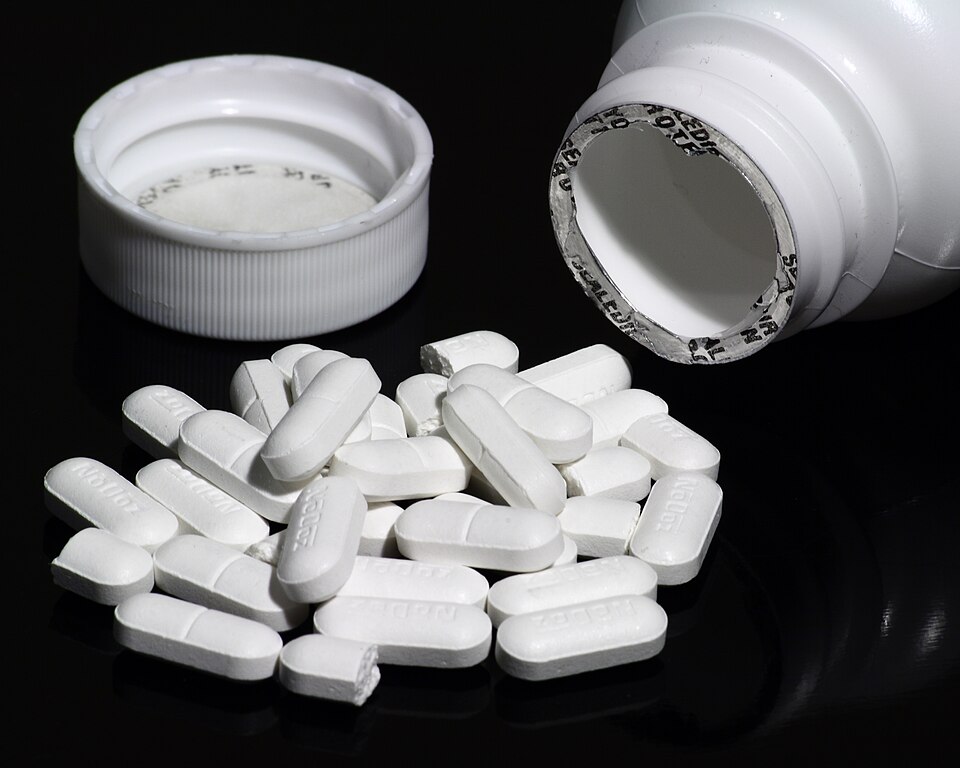
FIG. 2 · 2008-03-14 · CC BY-SA 4.0
Case two: modafinil
Modafinil’s US prescribing information describes a specific medical role.
PROVIGIL, a branded modafinil tablet, is a prescription medicine approved to improve wakefulness in adults with excessive sleepiness associated with narcolepsy, obstructive sleep apnoea or shift-work disorder LABEL-G02. In sleep apnoea, the label specifies, it treats the sleepiness, not the underlying obstruction of the airway LABEL-G02. It lists no approved use for improving intelligence, memory or study performance in healthy people.
The label is also candid about mechanism: the way modafinil promotes wakefulness "is unknown" LABEL-G02. It describes laboratory findings about how the drug interacts with the brain's dopamine system, but those findings do not by themselves establish the full wakefulness mechanism or prove general mental enhancement LABEL-G02.
In the 2021 trial, rested healthy men who took modafinil showed no statistically significant change on any test in the battery TRIAL-G01. The authors attributed this most likely to their small sample. The pilot was not large enough to detect small effects in people who were not sleep-deprived, they wrote, and they observed that earlier positive findings for modafinil came mostly from sleep-deprived volunteers TRIAL-G01.
A larger evidence base gives a similarly modest picture, though not a zero one. A 2020 series of meta-analyses on single doses in healthy, non-sleep-deprived adults reported, according to its abstract, a small overall effect of modafinil and a small effect on one memory measure (memory updating). It cautioned that laboratory experiments do not reflect how these drugs are used in real life EVID-G01. The authors judged popular expectations of effective cognitive enhancement to exceed the evidence they reviewed EVID-G01. We have read the abstract only.
These two findings can both be true. A small pilot can miss a small effect, and a pooled analysis can detect one. Neither shows that modafinil makes a healthy, rested person smarter in any broad sense. Nor is a sleep-disorder approval evidence of enhancement in people without the disorder.
The safety information is not trivial. PROVIGIL's label warns of serious, potentially life-threatening rashes, severe allergic and multi-organ reactions, psychiatric symptoms, and the possibility that a patient's sleepiness does not return to normal LABEL-G02. It also warns that hormonal contraceptives may be less effective while taking modafinil and for one month after stopping LABEL-G02. That interaction is one reason this guide connects to our history of the contraceptive pill the 1960 pill history. Federally, modafinil is a Schedule IV controlled substance LAW-G01; LABEL-G02.
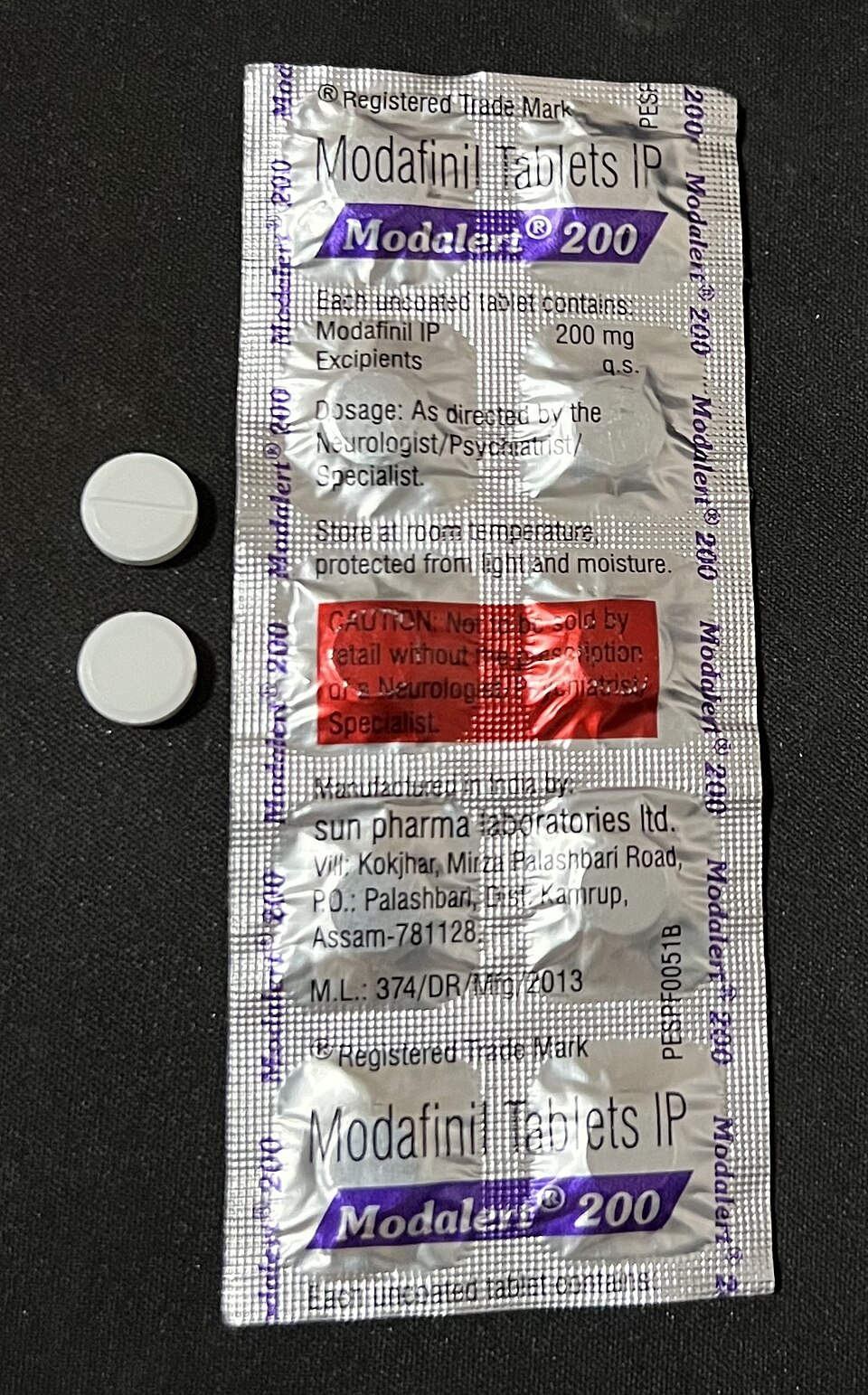
FIG. 3 · 2023-12-01 · CC0 1.0
Three shelves, three sets of rules
People who shop for "nootropics" often meet three very different kinds of product. They are not regulated the same way.
An OTC monograph drug. NoDoz’s product record lists OTC Monograph M011. FDA explains that monographs set marketing standards and that qualifying products can be marketed without an approved product-specific drug application LABEL-G01; REG-G02. That is not the same as the FDA individually approving this product as a new drug. Its label sets out a specific use and specific warnings. Its DEA schedule is listed as none LABEL-G01.
A prescription controlled substance. PROVIGIL is approved through a new drug application for defined medical uses, prescribed by a clinician and federally scheduled LABEL-G02; LAW-G01. Approval, prescription access and scheduling are three separate facts. None of them amounts to approval for cognitive enhancement.
Dietary supplements. A separate regulatory framework applies when a product is marketed as a dietary supplement. The FDA does not have authority to approve supplements for safety and effectiveness, or their labelling, before they are sold REG-N01. That does not make them unregulated. Companies are responsible for their products. A product marketed to treat or prevent disease can count as a drug under the law, and supplements can interact with medicines, interfere with lab tests and pose risks around surgery REG-N01.
A description such as research chemical or not for human consumption does not answer the evidence questions above. Those words alone establish neither clinical benefit nor lawful human use.
How to read a "smart drug" claim
Use the 2021 trial as a template. Its own design and limitations suggest what to ask of any claim.
- Who was studied? Rested healthy men, screened for medical and psychiatric conditions TRIAL-G01. Results may differ in women, older people, sleep-deprived people or patients.
- What was the comparison? Placebo, double-blind, with each person as his own control TRIAL-G01. A claim with no placebo comparison is much weaker.
- What exactly was measured? Named tasks, such as reaction time or recall of word lists, not "intelligence" TRIAL-G01.
- How big was the effect, and does it matter? A statistically detectable change on a lab task may or may not make a real-world difference. The trial's authors argued that enhancement should require at least a moderate benefit TRIAL-G01.
- Were many outcomes tested? This trial ran 45 statistical tests and corrected for multiple comparisons TRIAL-G01. Without correction, some "findings" in a large battery can appear by chance.
- Was the study big enough? The authors acknowledged that small effects could have gone undetected TRIAL-G01. A null result in a small study is not proof of no effect.
- Has it been replicated, and over what time? An acute study with a 24-hour follow-up cannot establish benefits or safety over months TRIAL-G01.
- What harms were recorded? Short laboratory tolerability is not a long-term safety record. Product labels list serious risks that small trials are not designed to detect LABEL-G02.
- What exactly is the product? A labelled OTC tablet, a prescription medicine and a bulk powder are not interchangeable, even when the main ingredient has the same name LABEL-G01; REG-G01; LABEL-G02.
The question to keep asking
Can drugs make you smarter? The evidence in this guide supports a narrower and more useful answer. Some substances can change specific, measured capacities for a short time in some people. In this trial, caffeine improved sustained attention in rested men TRIAL-G01, and a 2025 review abstract describes attention benefits in rested adults EVID-G02. A 2020 review abstract reports small effects for modafinil, while its authors judged that the popular belief in these drugs as effective cognitive enhancers is not supported so far EVID-G01. Modafinil's licensed role is treating excessive sleepiness from defined disorders, with a mechanism its own label calls unknown LABEL-G02.
So when you meet a promise of a sharper mind, ask: better at what, measured how, in whom, compared with what, and at what cost?
That question connects this guide to others on this site: the naming of the nootropic concept in the 1972 history 1972: The Birth of Nootropics, the contraceptive pill, whose effectiveness modafinil can reduce the 1960 pill history, and the transhumanist hope of improving the human mind the 1990 transhumanism history. The measured outcome matters more than the promise.
Substance Status & Safety
United States federal status only. Checked October 31, 2026. Informational, not medical advice. This section summarises specific sources; it is not a full toxicology or interaction review.
Caffeine — NoDoz Alertness Aid (a specific OTC product)
| Status | Human OTC drug, marketed under OTC Monograph M011; not an individual new-drug approval of the product. DEA schedule: none. Label "Updated January 6, 2025"; archive published date January 8, 2025 LABEL-G01; REG-G02 |
| Labelled use | Helps restore mental alertness or wakefulness when experiencing fatigue or drowsiness LABEL-G01 |
| Label warnings | For occasional use only. Not a substitute for sleep. Limit caffeine-containing medicines, foods and drinks: too much caffeine may cause nervousness, irritability, sleeplessness and occasionally rapid heartbeat. Not for children under 12. Stop and ask a doctor if fatigue or drowsiness persists or recurs. If pregnant or breastfeeding, ask a health professional first LABEL-G01 |
Caffeine — pure and highly concentrated products (a distinct formulation)
- FDA describes pure and highly concentrated caffeine products as a significant public-health threat that has contributed to at least two US deaths REG-G01.
- Bulk packages may hold thousands of servings. The gap between safe and toxic amounts is very small, and ordinary kitchen tools may not measure small servings accurately REG-G01.
- Toxicity signs: rapid or dangerously erratic heartbeat, seizures, vomiting, diarrhoea, stupor and disorientation. Fatal poisoning is possible. Pre-existing conditions can intensify effects REG-G01.
- FDA monitors these products, can seize products or seek injunctions, and has issued warning letters since September 2015 REG-G01.
- This warning concerns concentrated bulk products. It does not mean ordinary coffee carries identical risk, and it is not a complete list of caffeine's effects REG-G01.
Caffeine — mechanism and evidence
- Blocks adenosine receptors (types A1 and A2A), interfering with adenosine signalling; this is not a general intelligence pathway TRIAL-G01.
- Short-term attention benefits in rested healthy adults: one pilot trial TRIAL-G01 and a 2025 meta-analysis abstract EVID-G02. These do not establish long-term cognitive, academic or productivity benefits.
Modafinil — PROVIGIL (a specific prescription product)
| Status | Human prescription drug, new drug application (NDA020717). Federal Schedule IV controlled substance, drug code 1680. Label "Updated August 27, 2025" LABEL-G02; LAW-G01 |
| Approved uses | Improve wakefulness in adults with excessive sleepiness associated with narcolepsy, obstructive sleep apnoea (not treatment of the obstruction) or shift-work disorder. No approved cognitive-enhancement use. Not approved for children for any use LABEL-G02 |
| Mechanism | The mechanism through which it promotes wakefulness is unknown, according to the label LABEL-G02 |
| Contraindication | Known hypersensitivity to modafinil, armodafinil or the inactive ingredients LABEL-G02 |
Serious warnings in the label LABEL-G02:
- Serious rash, including Stevens-Johnson syndrome, has required hospitalisation. Rare serious or life-threatening skin reactions have been reported in adults and children. No factors are known to predict who will be affected. The label says treatment should be stopped at the first sign of rash unless it is clearly not drug-related, and that stopping may not prevent a rash from becoming life-threatening.
- Angioedema and anaphylaxis (severe allergic reactions) have been reported. Warning signs include swelling of the face, eyes, lips, tongue or larynx; difficulty swallowing or breathing; and hoarseness. Patients are to stop therapy and report immediately to their physician.
- Multi-organ hypersensitivity reactions, including at least one postmarketing death, have occurred. They can be life-threatening.
- Persistent sleepiness: wakefulness may not return to normal. Prescribers should reassess patients and may advise avoiding driving or other dangerous activities.
- Psychiatric symptoms have been reported, including, after marketing, mania, delusions, hallucinations, suicidal thoughts and aggression.
- Abuse potential: the label describes psychoactive and euphoric effects and advises close follow-up of patients with a history of drug or stimulant misuse.
Patient instruction (label counselling section): stop taking PROVIGIL and notify the doctor right away for a rash, hives, mouth sores, blisters, peeling skin, trouble swallowing or breathing, or a related allergic reaction LABEL-G02.
Interactions LABEL-G02:
- Hormonal contraceptives: the effectiveness of steroidal contraceptives may be reduced during treatment and for one month after stopping. The label recommends alternative or additional contraception over that period.
- The label lists other interactions, including effects on cyclosporine levels and on drugs broken down by certain liver enzymes. This guide does not cover the full list; discuss all medicines and supplements with a prescriber or pharmacist.
Overdose LABEL-G02: fatal overdoses have been reported after marketing, involving modafinil alone or with other drugs. Reported symptoms included insomnia; restlessness, disorientation, confusion, agitation, anxiety, excitation and hallucinations; nausea and diarrhoea; and fast or slow heart rate, high blood pressure and chest pain. Accidental ingestions by young children have been reported.
Evidence for enhancement: no significant effect in a small pilot of rested healthy men TRIAL-G01; small effects in a 2020 meta-analysis abstract, with doubts about real-world relevance EVID-G01.
Dietary supplements sold as "nootropics"
FDA does not approve dietary supplements for safety or effectiveness before sale, but it still regulates them and can act against unsafe products. Manufacturers are responsible for their products. Products intended to treat disease can be regulated as drugs. Supplements can interact with medicines, interfere with lab tests and be dangerous around surgery REG-N01. This guide makes no claim about any specific supplement ingredient.
Lethal-dose evidence and its limits
The sources reviewed document deaths linked to concentrated caffeine products REG-G01 and fatal postmarketing overdoses involving modafinil LABEL-G02. They do not establish a reliable universal lethal amount for either substance, and this guide does not give one. Outcomes vary with product, formulation, the person, their health and other drugs taken. Animal toxicity figures are not human thresholds. No established threshold does not mean safe. A comprehensive human toxicity and interaction review is outside this guide.
When to get help
- Poison Control (US): 1-800-222-1222, free and confidential; online help is also available HELP-N01.
- Call 911 immediately if someone collapses, has a seizure, has trouble breathing or can't be awakened HELP-N01.
- For PROVIGIL rash or allergic signs, follow the label instructions above.
- Neither NoDoz nor PROVIGIL is a replacement for sleep. For routine treatment questions, contact the prescriber; the label’s urgent reaction instructions remain separate LABEL-G01; LABEL-G02.
Sources & Further Reading
-
[HIST-N01] Malík M, Tlustoš P. "Nootropics as Cognitive Enhancers: Types, Dosage and Side Effects of Smart Drugs." Nutrients 14(16):3367 (2022). doi:10.3390/nu14163367. Open access. Used for history and terminology only. https://doi.org/10.3390/nu14163367
-
[TRIAL-G01] Repantis D, Bovy L, Ohla K, Kühn S, Dresler M. "Cognitive enhancement effects of stimulants: a randomized controlled trial testing methylphenidate, modafinil, and caffeine." Psychopharmacology 238:441–451 (2021). doi:10.1007/s00213-020-05691-w. Open access: https://pmc.ncbi.nlm.nih.gov/articles/PMC7826302/
-
[EVID-G01] Roberts CA, Jones A, Sumnall H, Gage SH, Montgomery C. "How effective are pharmaceuticals for cognitive enhancement in healthy adults? A series of meta-analyses of cognitive performance during acute administration of modafinil, methylphenidate and D-amphetamine." European Neuropsychopharmacology 38:40–62 (2020). doi:10.1016/j.euroneuro.2020.07.002. Abstract: https://pubmed.ncbi.nlm.nih.gov/32709551/ (abstract read; full text not read).
-
[EVID-G02] Kløve K, Petersen A. "A systematic review and meta-analysis of the acute effect of caffeine on attention." Psychopharmacology 242:1909–1930 (2025). doi:10.1007/s00213-025-06775-1. Abstract: https://pubmed.ncbi.nlm.nih.gov/40335666/ (abstract read; full text not read).
-
[LABEL-G01] NoDoz Alertness Aid (caffeine) Drug Facts label, Lil' Drug Store Products. DailyMed: https://dailymed.nlm.nih.gov/dailymed/drugInfo.cfm?setid=e700e809-29b5-799e-e053-2a95a90a235c
-
[LABEL-G02] PROVIGIL (modafinil) US prescribing information, Apotex Corp. DailyMed: https://dailymed.nlm.nih.gov/dailymed/drugInfo.cfm?setid=0391f182-1958-9fef-a944-53b229ce99e7
-
[REG-G01] US Food and Drug Administration. "Pure and Highly Concentrated Caffeine." https://www.fda.gov/food/information-select-dietary-supplement-ingredients-and-other-substances/pure-and-highly-concentrated-caffeine
-
[REG-N01] US Food and Drug Administration. "FDA 101: Dietary Supplements." https://www.fda.gov/consumers/consumer-updates/fda-101-dietary-supplements
-
[LAW-G01] 21 CFR 1308.14(f)(7), Schedule IV (modafinil, drug code 1680). eCFR: https://www.ecfr.gov/current/title-21/chapter-II/part-1308/section-1308.14
-
[HELP-N01] National Capital Poison Center (Poison Control). "First Aid Guidelines." https://www.poison.org/first-aid-for-poisonings
- [REG-G02] FDA, Small Business Assistance: Frequently Asked Questions on the Regulatory Process of Over-the-Counter (OTC) Drugs, questions 3 and 9. https://www.fda.gov/drugs/cder-small-business-industry-assistance-sbia/small-business-assistance-frequently-asked-questions-regulatory-process-over-counter-otc-drugs (Relevant passages read October 31, 2026.)
Explore the connections
- TOPIC Nootropics
- TOPIC Human Enhancement Ethics